Science Rewrites Wildfire Story: Defending Homes
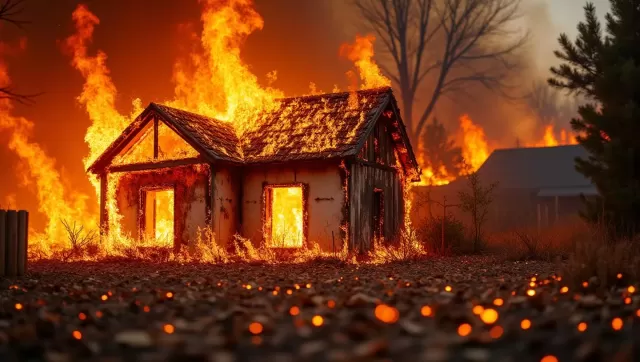
Wildfires are becoming increasingly frequent and devastating, particularly in areas where urban development meets natural landscapes – the wildland-urban interface (WUI). While fighting fires is crucial, a growing body of research highlights the importance of preventing homes from igniting in the first place. Embers, seemingly insignificant sparks carried by the wind, are the primary culprit, responsible for a staggering 60% to 90% of home ignitions.
This article explores how scientific research is leading to innovative strategies for making communities more resilient to wildfires, focusing on community-wide prevention and protection measures.
The Ember Threat: An Invisible Enemy
Imagine a house standing seemingly safe, but then, imagine tiny embers, traveling unseen, landing on vulnerable spots. These embers find fuel in dry leaves, wood piles, or even a neglected cardboard-filled trash bin. It's a slow burn that can quickly explode into a full-blown inferno.
Traditional fire control methods often falter under extreme conditions. Instead, the focus needs to shift towards fire-resistant community design and construction. As retired U.S. Forest Service fire scientist Jack Cohen puts it, "It's not a wildfire problem. It's a structure ignition problem."
Science in Action: Understanding Fire's Weak Points
Researchers like Alexander Maranghides at the National Institute of Standards and Technology (NIST) are leading the charge in understanding how wildfires interact with structures. Through meticulous experiments, often conducted in controlled environments like the National Fire Research Laboratory, scientists are uncovering critical vulnerabilities.
Key Research Areas:
- Ember behavior: How far embers travel, where they land, and what ignites them.
- Material flammability: Assessing the fire resistance of different building materials (siding, roofing, fencing).
- Structural design: Identifying design flaws that promote fire spread.
- Community-level dynamics: Understanding how fire spreads from one house to another in densely populated areas.
For instance, NIST researchers discovered that wooden fences can act as conduits for fire, leading to recommendations for fire-resistant fencing materials and designs. They also found that sheds placed too close to homes can act as "wind amplifiers," intensifying flames and accelerating fire spread. These findings are then translated into practical guidelines for communities.
The NIST Hazard Mitigation Methodology: A Blueprint for Resilience
NIST's Hazard Mitigation Methodology (HMM) provides a comprehensive framework for building fire-adapted communities. It identifies dozens of vulnerabilities and offers actionable strategies for mitigation.
Key Principles of the HMM:
- Structure Hardening: Strengthening homes with fire-resistant materials and designs, such as metal siding, enclosed eaves, and dual-paned windows.
- Exposure Reduction: Removing or relocating flammable materials around the home, including patio furniture, landscaping mulch, and vehicles.
- Community Involvement: Recognizing that fire resilience is a collective effort, requiring participation from all residents.
Comparing NIST Hazard Mitigation Methodology with Traditional Fire Codes
| Feature | NIST HMM | Traditional Fire Codes |
|---|---|---|
| Scope | Community-wide | Individual property |
| Ember Focus | Comprehensive | Often lacking |
| Flame Vulnerabilities | Comprehensive | Often incomplete |
| Preventive Emphasis | High | Lower |
The HMM goes beyond conventional fire codes by emphasizing community-scale efforts. Fire doesn't respect property lines. A single vulnerable home can jeopardize an entire neighborhood.
Community-Wide Hardening: A Collective Defense
Imagine a neighborhood as a chain, where the chain is only as strong as its weakest link. If one house is vulnerable, it becomes a threat to its neighbors. Flames can easily spread to nearby structures, creating a destructive domino effect. The solution lies in community-wide hardening – ensuring that every home is protected.
The 50-Foot Rule: Fires can easily spread to structures within 50 feet.
Real-World Examples: Success Stories and Ongoing Efforts
While community-wide hardening is still in its early stages, there are encouraging examples of its implementation.
- Dixon Trail, Escondido, California: This new community of 64 homes is the first to receive the Wildfire Prepared Neighborhood designation from the Insurance Institute for Business & Home Safety (IBHS). The homes feature fire-resistant construction, enclosed eaves, and a five-foot defensible space around each structure. As a result, all homes are insured despite California's challenging insurance market.
- Kelseyville Riviera, California: Through the California Wildfire Mitigation Program, this at-risk community is receiving assistance with home retrofits. Local organizations are working directly with residents to implement fire-resistant measures.
Challenges and Future Directions
Despite the growing recognition of the importance of fire prevention, significant challenges remain.
- Cost: Retrofitting existing homes can be expensive, potentially limiting participation.
- Policy: Alignment of federal, state, and local policies is needed to support community-wide hardening efforts.
- Awareness: Educating homeowners about the risks and benefits of fire prevention is crucial.
Chart: Barriers to Community-Wide Fire Hardening
(A pie chart showing the relative importance of various barriers, such as cost, lack of awareness, policy gaps, and community apathy).
The Path Forward: A Call to Action
Protecting communities from wildfires requires a multi-faceted approach, including:
- Increased research: Continued investment in scientific research to better understand fire behavior.
- Policy reform: Enacting policies that incentivize community-wide fire hardening.
- Community engagement: Empowering residents to take action to protect their homes and neighborhoods.
- Financial assistance: Providing grants and low-interest loans to help homeowners retrofit their properties.
The threat of wildfires is a solvable problem. By embracing science-based strategies and working together, we can create communities that are resilient to the inevitable flames. As Maranghides envisions, a future where wildfires approach a community and simply peter out, unable to find fuel or a foothold.
Don't wait for your local government or insurance company to act. There are things you can do today to protect your home and your community. The goal is not just insurability but survivability.
Resources
- National Institute of Standards and Technology (NIST) Hazard Mitigation Methodology
- Insurance Institute for Business & Home Safety (IIBHS) Wildfire Prepared Neighborhood Standard