Rapid Lake Drainage Fractures Greenland Glacier
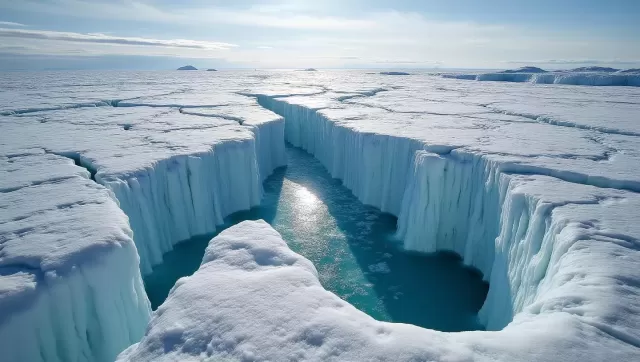
A new study reveals a dramatic transformation on Greenland's 79°N Glacier, where a large meltwater lake first appeared in 1995. Prior to the mid-1990s, this region of the glacier was completely devoid of surface lakes. Since its formation, this lake has not remained a stable feature. Instead, it has undergone repeated and sudden drainage events, sending vast quantities of freshwater toward the ocean beneath the glacier's floating tongue. Scientists have recorded seven major drainages, with an accelerated frequency—four of these events have occurred within the last five years alone.
Unprecedented Fractures and Deep Vertical Shafts
These rapid drainage events have reshaped the glacier's surface in unexpected ways. From 2019 onward, extensive fields of triangular fractures have formed, a pattern distinct from typical glacial lake drainages. Many of these cracks have evolved into giant vertical shafts called moulins, some with surface openings spanning dozens of meters. These structures act as direct pipelines to the glacier's base, enabling meltwater to travel from the surface to the bedrock in a matter of hours. For the first time, researchers have been able to measure the evolution of these internal drainage channels over multiple years.
The Cycle of Cracking and Healing in Glacier Ice
The behavior of the ice itself explains this cycle of damage and repair. Glacier ice possesses two key mechanical properties:
- It flows viscously, like an extremely slow-moving fluid.
- It also behaves elastically, able to bend and partially rebound, similar to a stiff rubber band.
This elasticity allows fractures and moulins to open during sudden water drainage. Subsequently, the ice's viscous flow gradually works to close these channels over time. Despite this healing process, radar imagery confirms that the large triangular moulins remain detectable within the ice for years after they form, indicating a persistent, interconnected network of waterways inside the glacier.
Meltwater Lifts the Glacier from Below
Aerial imagery provided further clues, showing shadow patterns and height disparities along fracture lines. In some cases, one side of a moulin appeared raised higher than the other. The most significant uplift was detected directly below the main lake basin. There, radar data revealed a "blister" of water—a subglacial lake—that had pooled under the ice, visibly lifting the entire glacier surface upward. Remarkably, surface scars from the earliest drainage events over 15 years ago remain visible today.
Monitoring a Glacier's New Normal
The research combined satellite remote sensing, airborne surveys, and viscoelastic modeling to track the lake's cycles and the subsequent water pathways. A critical question remains: Has the glacier entered a new, permanent state due to these repeated hydraulic shocks, or can it still recover during winter? The system has developed a recurring pattern of massive, abrupt water input within hours or days. It is not yet known if the glacial system can absorb this level of extreme disturbance or if it possesses feedback mechanisms to regulate the drainage.
Why Fracture Dynamics Are Crucial for Future Predictions
These observations provide essential data for improving the accuracy of ice sheet models. Traditionally, models have struggled to incorporate the dynamic formation and evolution of cracks and moulins. As atmospheric temperatures continue to rise, these fracture systems are forming at higher elevations, affecting ever-larger portions of the ice sheet. Understanding and simulating this process is therefore vital for predicting the stability of Greenland's ice and its contribution to sea-level rise in a warming climate.